
Retirement Calculator
Estimate the retirement corpus and monthly investment needed based on your inputs.
Year-wise Corpus Growth
Year-wise Growth Table
| Year | Estimated Corpus | Annual Investment |
|---|
Calculate Retirement Corpus & Monthly SIP Requirements
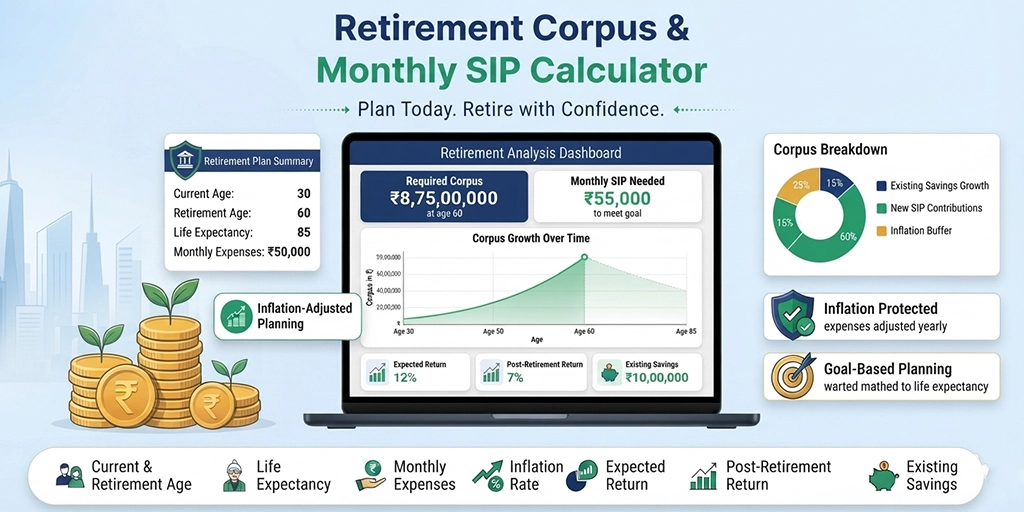
Finmarra’s Retirement Calculator estimates the corpus you may need at retirement and the monthly investment required to work toward that goal. It considers factors such as your current age, retirement age, monthly expenses, inflation, expected returns, life expectancy, and existing savings. Enter your basic financial details to estimate your future monthly expenses, retirement corpus, existing savings value, retirement gap, and monthly SIP requirement.
What Is a Retirement Calculator?
A Retirement Calculator estimates how much you may need to save for retirement and how much you may need to invest today. It considers your current expenses, retirement age, inflation, expected investment returns, retirement period, and existing savings to estimate your future financial requirements.
The calculator adjusts your current monthly expenses for inflation and estimates the corpus required to support those expenses during retirement. It can also consider existing investments such as EPF, PPF, NPS, mutual funds, and other retirement savings when calculating the potential retirement gap.
The calculator can support both SIP and lump sum planning. The results depend on the assumptions you enter, including inflation and expected returns. Actual investment returns and future expenses may differ from these estimates. The results are for financial planning and estimation purposes only and do not guarantee future returns.
In simple terms, a retirement calculator connects your current financial position with your future retirement income requirements.
HHow Can a Retirement Calculator Help You?
A Retirement Calculator helps estimate the corpus you may need at retirement and the amount you may need to invest during your working years. It considers inflation, current expenses, existing savings, expected returns, and the time available for investment.
Estimate Retirement Corpus
The calculator estimates the retirement corpus based on your future expenses, retirement period, inflation assumptions, and expected post retirement returns.
Calculate Monthly SIP Requirement
It estimates the monthly SIP required to work toward the target retirement corpus based on your investment period and expected return rate.
Factor Inflation Impact
It shows how inflation can increase your current monthly expenses by the time you reach retirement.
Consider Existing Savings
The calculator can include existing savings and investments such as EPF, PPF, NPS, mutual funds, and other retirement investments.
Understand Retirement Gap
It compares the estimated retirement corpus with the projected value of your existing savings to show the additional amount you may need to accumulate.
How to Use the Retirement Calculator
Step 1: Enter Your Current Age
Enter your current age to determine how many years you have until your planned retirement.
Step 2: Enter Retirement Age
Enter the age at which you plan to retire. This determines your investment period and helps estimate your future expenses. investment amount.
Step 3: Add Monthly Expenses
Enter your current monthly household and lifestyle expenses. The calculator uses this amount as the starting point for future expense projections.
Step 4: Set Inflation and Return Assumptions
Enter the expected inflation rate and investment return rate. These assumptions help estimate future expenses and potential investment growth.
Step 5: Add Existing Savings
Enter your current retirement savings and investments, such as EPF, PPF, NPS, mutual funds, or other eligible investments.
Step 6: Enter Life Expectancy
Enter the age until which you want your retirement corpus to support your expenses. This helps estimate the potential retirement period.
Step 7: View Your Results
The calculator displays:
- Estimated retirement corpus required
- Inflation adjusted monthly expenses at retirement
- Projected value of existing savings
- Additional retirement corpus required
- Estimated monthly SIP requirement
Inputs Required
The Retirement Calculator requires the following inputs:
- Current Age:Your present age when you start planning for retirement.
- Retirement Age:The age at which you plan to retire.
- Life Expectancy:The age until which you want your retirement corpus to support your planned expenses.
- Monthly Expenses:Your current monthly lifestyle and household expenses.
- Inflation Rate:The expected annual inflation rate used to estimate future expenses.
- Expected Return Rate:The estimated annual return from your investments before retirement.
- Post Retirement Return Rate:The estimated annual return on your retirement corpus after retirement.
- Existing Savings:Your current retirement savings and investments, such as EPF, PPF, NPS, mutual funds, and deposits.
Retirement Calculator Formula
The calculator uses standard financial planning formulas to estimate future expenses, investment growth, retirement requirements, and SIP contributions.
Inflation Adjusted Expense Formula
Future Monthly Expense: Current Monthly Expense × (1 + Inflation Rate) ^ Years to Retirement
This formula estimates how your current monthly expenses may change because of inflation.
Future Value of Existing Savings
Future Value: Existing Savings × (1 + Return Rate) ^ Years to Retirement
This estimates the potential value of your current savings at retirement based on the assumed return rate.
Retirement Corpus Calculation
The retirement corpus depends on the inflation adjusted expenses, retirement period, and assumed post retirement return. The calculator estimates the corpus required to support your planned monthly expenses throughout the retirement period while considering the assumed post retirement return.
SIP Calculation
The required SIP is calculated using the future value of a monthly investment formula. It considers the retirement gap, investment period, expected return, and monthly compounding. These formulas use assumptions and estimates. Actual investment performance, inflation, expenses, and retirement needs can differ.
What the Calculator Shows
Retirement Corpus Required
The estimated amount you may need at retirement to support your planned expenses during retirement.
Future Monthly Expenses
Your estimated monthly expenses at retirement after applying the assumed inflation rate.
Existing Savings Value
The estimated future value of your current savings based on the assumed investment return.
Retirement Gap
The difference between the estimated retirement corpus and the projected value of your existing savings.
Monthly SIP Requirement
The estimated monthly investment required to work toward the retirement gap during your remaining working years.
Example Retirement Calculation
Example Retirement Planning Scenario
Consider an individual with the following assumptions:
Current Age: 30 Years
Retirement Age: 60 Years
Life Expectancy: 85 Years
Current Monthly Expenses: ₹50,000
Expected Inflation Rate: 6% Per Year
Expected Pre Retirement Return: 12% Per Year
Expected Post Retirement Return: 8% Per Year
Existing Retirement Savings: ₹5,00,000
Estimated Results
Based on these assumptions:
Future Monthly Expenses at Retirementt: Approximately ₹2.87 Lakh
Estimated Retirement Corpus Required: Approximately ₹5.5 Crore
Projected Value of Existing Savings: Approximately ₹1.50 Crore
Estimated Additional Corpus Required: Approximately ₹4 Crore
Estimated Monthly SIP Requirement: Approximately ₹17,000
These figures provide an illustration of how retirement planning calculations work. The actual result will depend on the calculator inputs, calculation methodology, investment returns, inflation, retirement period, and other assumptions.
Retirement Corpus vs Monthly SIP Planning
Retirement corpus and SIP calculations serve different purposes. The corpus calculation estimates how much you may need at retirement, while the SIP calculation estimates how much you may need to invest regularly to work toward that target.
| Factor | Retirement Corpus | Monthly SIP Planning |
|---|---|---|
| Purpose | Estimates the retirement goal | Estimates the regular investment needed |
| Focus | Future retirement income needs | Current investment requirement |
| Influenced By | Expenses, inflation, life expectancy, and post retirement returns | Corpus gap, expected returns, and investment period |
| Output | Estimated retirement corpus | Estimated monthly SIP |
| Planning Stage | Goal setting | Goal accumulation |
| Suitable For | Assessing retirement requirements | Planning regular investments |
Which Should You Focus On?
Both calculations play an important role in retirement planning. First, estimate the corpus you may need based on your future expenses and retirement period. Then, calculate how much you may need to invest regularly to work toward that target. Looking at both figures gives you a clearer view of your retirement goal, existing savings, investment requirement, and potential funding gap.
Advantages of Using a Retirement Calculator
Quick Retirement Estimates
Get an estimate of your retirement corpus based on your age, expenses, inflation, retirement period, and expected returns.
Understand Inflation Impact
See how inflation may increase your current expenses by the time you reach retirement.
Calculate Required SIP
Estimate the monthly SIP that may be required to work toward your retirement corpus.
Factor in Existing Savings
Include existing investments such as EPF, PPF, NPS, mutual funds, and other savings when assessing your retirement position.
Better Long Term Planning
Understand your potential future expenses, existing savings growth, retirement corpus requirement, and additional investment needs.
Retirement Planning Tax Benefits in India
Retirement planning may involve investment and employment linked savings schemes that can offer tax benefits subject to applicable rules. The availability and amount of tax benefits depend on factors such as eligibility, contribution type, withdrawal conditions, and the applicable tax regime.
| Investment Option | Potential Tax Benefit |
|---|---|
| NPS | Deductions may be available under Sections 80CCD(1), 80CCD(1B), and 80CCD(2), subject to applicable conditions |
| EPF | Tax treatment depends on contribution, interest, withdrawal, and applicable conditions |
| PPF | Contributions may qualify for deduction under Section 80C, subject to applicable conditions |
| Gratuity | Eligible gratuity may qualify for exemption under Section 10(10), subject to applicable conditions |
| Leave Encashment | Eligible leave encashment may qualify for exemption under applicable provisions |
Tax treatment can change based on applicable laws, eligibility, withdrawal conditions, and the tax regime selected. Consult a qualified tax professional for advice based on your circumstances.
NPS vs EPF vs PPF for Retirement Planning
| Feature | NPS | EPF | PPF |
|---|---|---|---|
| Primary Purpose | Retirement corpus creation | Employee retirement savings | Long term savings |
| Market Exposure | Market linked | Interest based | Interest based |
| Lock in | Subject to NPS withdrawal and exit rules | Linked to employment and applicable withdrawal rules | 15 year initial tenure, subject to applicable rules |
| Tax Benefits | Available under applicable sections and conditions | Subject to applicable tax rules | Contributions may qualify under Section 80C |
| Suitable For | Long term retirement planning | Salaried employees and eligible employees | Investors seeking long term savings |
Retirement planning can involve a combination of savings and investment options. The right combination depends on factors such as income, investment horizon, risk tolerance, existing savings, retirement goals, and applicable tax rules
FAQs About Retirement Planning & Corpus Calculation
How much retirement corpus is needed to retire in India?
The required retirement corpus depends on your retirement age, current expenses, inflation, life expectancy, expected investment returns, and post retirement income needs. Finmarra’s Retirement Calculator estimates the potential corpus based on these factors instead of using a fixed amount for everyone.
Is ₹2 crore enough to retire in India?
₹2 crore may be sufficient for some retirement plans but may not be enough for others. The requirement depends on your retirement age, lifestyle, inflation, healthcare costs, life expectancy, other income sources, and investment returns. Use a retirement corpus calculator to estimate your potential requirement based on your own inputs.
How does a retirement planning calculator in India estimate future expenses?
A retirement planning calculator applies an assumed inflation rate to your current expenses based on the number of years remaining until retirement. This helps estimate the monthly expenses you may need to meet after retirement.
What is the difference between a retirement corpus calculator and a retirement SIP calculator?
A retirement corpus calculator estimates the amount you may need at retirement. A retirement SIP calculator estimates the regular monthly investment that may help you work toward that target over a specific investment period.
Does the Retirement Calculator consider existing savings?
Yes. Finmarra’s Retirement Calculator can consider existing savings and investments such as EPF, PPF, NPS, mutual funds, and other eligible investments. Their projected value can reduce the additional corpus you may need to accumulate.
How does inflation affect retirement planning?
Inflation can increase the cost of living over time. A monthly expense that seems manageable today may require a much larger amount in the future. Including an inflation assumption helps estimate the potential increase in expenses before and during retirement.
Can I include EPF, PPF, and NPS while planning retirement?
Yes. You can consider EPF, PPF, NPS, mutual funds, and other retirement savings when assessing your overall retirement position. The treatment of each investment depends on its applicable rules and assumptions.
What return rate should I use in a retirement calculator?
The return assumption should reflect your investment mix, risk tolerance, investment horizon, and the type of assets you hold. Using a realistic assumption can produce a more useful retirement estimate. You should avoid assuming unusually high returns simply to reduce the required monthly investment.
What are the NPS tax benefits available under Section 80CCD?
Depending on eligibility and applicable conditions, NPS contributions may qualify for deductions under Section 80CCD(1), an additional deduction under Section 80CCD(1B), and eligible employer contributions under Section 80CCD(2). The limits and rules depend on the applicable tax provisions and tax regime.
When should retirement planning start?
Starting earlier gives your investments more time to compound and can reduce the monthly amount you may need to invest to reach a particular goal. However, you can start retirement planning at any age by assessing your current savings, future expenses, investment horizon, and retirement objectives.
Popular Calculators

ELSS Calculator

Capital Gains Calculator

Car Loan EMI Calculator

Bond Yield Calculator

CAGR Calculator

Down Payment Calculator

Personal Loan EMI Calculator

Home Loan EMI Calculator

Fixed Deposit (FD) Calculator

ROI Calculator

Lumpsum Calculator

Mutual Fund Calculator

SSY Calculator

Financial Goal Planner Calculator

SWP Calculator

EPF Calculator

Inflation Calculator