
CAGR Calculator
Estimate the compounded annual growth rate and year-wise value growth.
Year-wise Value Growth
Year-wise Growth Table
| Year | Value at Year End | Growth in Year |
|---|
Calculate CAGR & Compare Investment Growth Instantly
Using Finmarra's CAGR Calculator, you can calculate the annualized rate of growth for your investments during a particular period. Input the Start Value, End Value and Time of Investment to compute CAGR in seconds. The compound annual growth rate is instantly displayed on the calculator, enabling you to assess an investment's performance and compare results with different investment options from the same screen.
What Is a CAGR Calculator?
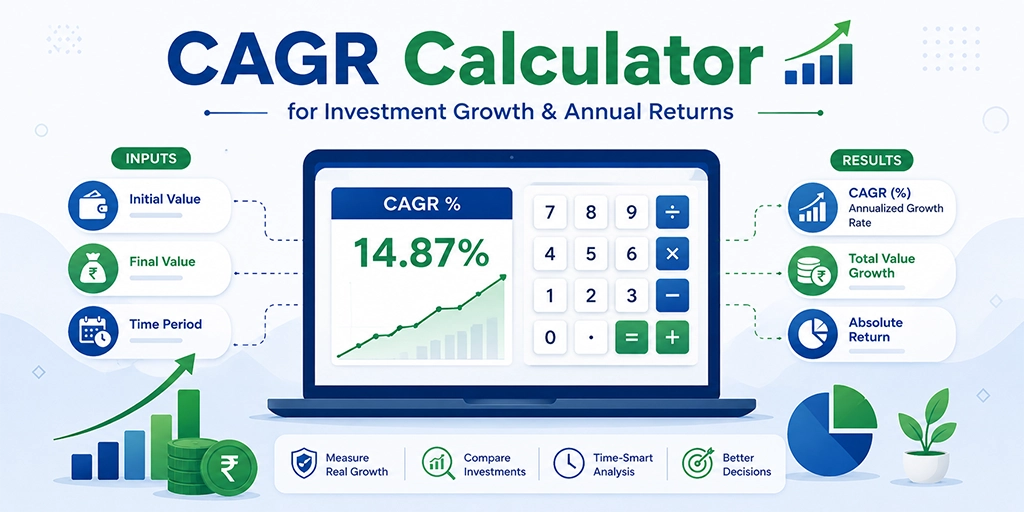
CAGR Calculator is a tool used in investment planning to determine the Compound Annual Growth Rate (CAGR) of an investment for a given time. It represents the annual rate of growth of an investment from its initial to final value.
CAGR is calculated with the initial value, final value and the length of the investment. This enables investors to assess performance and compare returns on various investment options.
The principle of CAGR assumes that the growth rate is the same every year. The actual returns may differ from year to year, and the computed CAGR is an annualized average return.
A CAGR Calculator is a straightforward tool that aids in assessing long-term investment growth and in evaluating investment performance more effectively.
How Can a CAGR Calculator Help You?
A CAGR Calculator helps you understand the annual growth rate of an investment between two points in time. It converts total growth into a steady yearly percentage for easy comparison.
Measure Annualized Growth
The calculator shows how much an investment has grown each year on average. It smooths out ups and downs and gives a single growth rate over the full period.
Compare Different Assets
You can compare returns from stocks, mutual funds, real estate, or any lump-sum investment. It helps identify which asset delivered better long-term growth.
Understand True Performance Over Time
Instead of just looking at total profit, CAGR shows how the investment performed yearly. This gives a clearer picture of long-term efficiency.
Separate Growth from Volatility
Short-term price movements are ignored. The calculator focuses only on start value, end value, and time period to show stable growth rate.
Save Time and Avoid Manual Calculation
The result is calculated instantly without using formulas. It helps investors compare different investments quickly and accurately.
How to Use the CAGR Calculator
Step 1: Enter Initial Value
Enter the starting investment amount or initial value of the asset. This is the base value used for growth calculation.
Step 2: Enter Final Value
Add the ending value of your investment at the end of the selected time period. This represents the total accumulated value.
Step 3: Select Investment Duration
Choose the time period in years. CAGR depends on the total holding period between start and end values.
Step 4: View CAGR Result
The calculator shows the annual growth rate (CAGR %) based on your inputs. It converts total growth into a single yearly compounded rate.
Step 5: Check Absolute Return
You can also view total profit or loss in percentage and value terms without considering time.
Step 6: Compare Growth Scenarios
Adjust values to compare different investment outcomes. This helps evaluate which asset performed better over the same or different time periods.
Inputs Required
The CAGR Calculator requires the following inputs:
Initial Value
Enter the starting value of the investment or asset.
Final Value
Enter the value at the end of the investment period.
Time Period
Select the number of years the investment was held.
CAGR Formula
The calculator uses the standard compound annual growth rate formula.
CAGR Formula:
CAGR = (Final Value / Initial Value)^(1 / Years) − 1
Where:
Initial Value = Starting investment amountFinal Value = Ending investment valueYears = Holding period in years
Year-wise Value
Value after year t:
Value_t = B * (1 + CAGR)^t
What the Calculator Shows
CAGR (%)
The annualized compounded growth rate of your investment over time.
Absolute Return
Total percentage change between initial and final value, ignoring time.
Total Value Growth
Difference between final and initial value in absolute terms.
Annualized Performance
A single yearly growth rate used to compare investments across different time periods.
Example CAGR Calculation
Example Investment Scenario
Initial Investment: ₹1,00,000
Final Value: ₹2,00,000
Investment Duration: 5 Years
Estimated Results
CAGR: 14.87% per year
Total Value Growth: ₹1,00,000
Absolute Return: 100%
Actual returns may vary depending on market conditions and asset performance.
CAGR vs Absolute Return
CAGR and absolute return measure investment performance in different ways. CAGR refers to growth in annual periods, absolute return refers to the overall gain or loss between two values.
| Factor | CAGR | Absolute Return |
|---|---|---|
| Measurement | Annualized growth rate | Total return over period |
| Time Factor | Included | Not considered |
| Output Type | Percentage per year | Total percentage change |
| Best Use | Long-term comparison | Short-term performance |
| Volatility Impact | Smoothed | Fully reflected |
Which One Should You Use?
The CAGR is useful for comparing the growth of investments that have a longer timeframe as it takes into account time and the smoothing of growth. Absolute return is useful when you only need total gain or loss without adjusting for the investment period.
Advantages of Using a CAGR Calculator
Quick and Accurate Estimates
Get instant annualized growth rate without manual calculations.
Better Investment Comparison
Compare returns across stocks, mutual funds, or real estate using a common time-adjusted metric.
Clear View of True Performance
Understand long-term performance by removing short-term market fluctuations.
Supports Smarter Decisions
Helps evaluate whether an investment delivered steady long-term growth.
Saves Time in Analysis
Gives instant results for multiple scenarios without manual effort.
CAGR vs Other Return Metrics
| Feature | CAGR | Absolute Return | IRR |
|---|---|---|---|
| Time Factor | Included | Not considered | Included |
| Cash Flow Type | Single investment | Single investment | Multiple flows |
| Output | Annual growth rate | Total return | Discounted return rate |
| Best Use | Long-term comparison | Basic performance check | Complex cash flow analysis |
| Volatility Impact | Smoothed | Fully reflected | Smoothed with timing effect |
Understanding CAGR in Real Analysis
CAGR is used to measure long-term investment performance by converting total growth into a single annual rate.
- Helps compare investments on a common time-adjusted scale
- Works best for lump-sum assets like stocks, mutual funds, and real estate
- Uses only initial and final values for calculation
- Useful for evaluating consistent long-term growth patterns
The use of CAGR is most useful when comparing lump-sum investments over periods of time with a single annualized benchmark.
Frequently Asked Questions on CAGR Calculator
What is a CAGR calculator and how is it used?
A CAGR calculator shows the annual growth rate of an investment between initial and final value over time. At Finmarra, it is used to evaluate long-term performance of stocks, mutual funds, and other lump-sum investments.
How is CAGR calculated in simple terms?
CAGR is calculated using initial value, final value, and time period. It converts total growth into a yearly growth rate using a standard formula, without manual calculation.
Why is CAGR better than absolute return?
CAGR includes time in the calculation, while absolute return shows only total gain or loss. This makes CAGR more useful for comparing long-term investment performance.
Can a CAGR calculator be used for mutual funds and stocks?
Yes, the CAGR calculator helps measure and compare mutual fund and stock performance over time by showing annualized returns in a simple format.
What does a CAGR calculator show?
It shows CAGR percentage, total value growth, and absolute return. This helps understand both yearly performance and total profit.
Is CAGR suitable for all investments?
CAGR works best for single investments with clear start and end values. For multiple transactions, XIRR is more suitable.
How does Finmarra use the CAGR calculator?
We use it to help investors compare long-term returns across different asset classes and understand growth in a clear, time-adjusted way.
What is a good CAGR percentage?
A good CAGR depends on market type. For equity investments, many investors consider 10%–15% as a healthy long-term range.
Can CAGR compare different time periods?
Yes, CAGR converts returns into annual rates, making it easier to compare investments with different holding periods.
Does CAGR show yearly fluctuations?
No, CAGR only shows overall annualized growth. It does not reflect year-to-year market movements.
Popular Calculators

ELSS Calculator

Capital Gains Calculator

Car Loan EMI Calculator

Bond Yield Calculator

Down Payment Calculator

Personal Loan EMI Calculator

Home Loan EMI Calculator

Fixed Deposit (FD) Calculator

ROI Calculator

Lumpsum Calculator

Mutual Fund Calculator

SSY Calculator

Financial Goal Planner Calculator

SWP Calculator

EPF Calculator

Inflation Calculator

Net Worth Calculator

Retirement Calculator