
ELSS Calculator
Estimate ELSS SIP or lumpsum growth and annual tax savings.
Year-wise Value Growth
Year-wise Growth Table
| Year | Value at Year End | Growth in Year |
|---|
Calculate Your ELSS Returns and Tax Savings Instantly
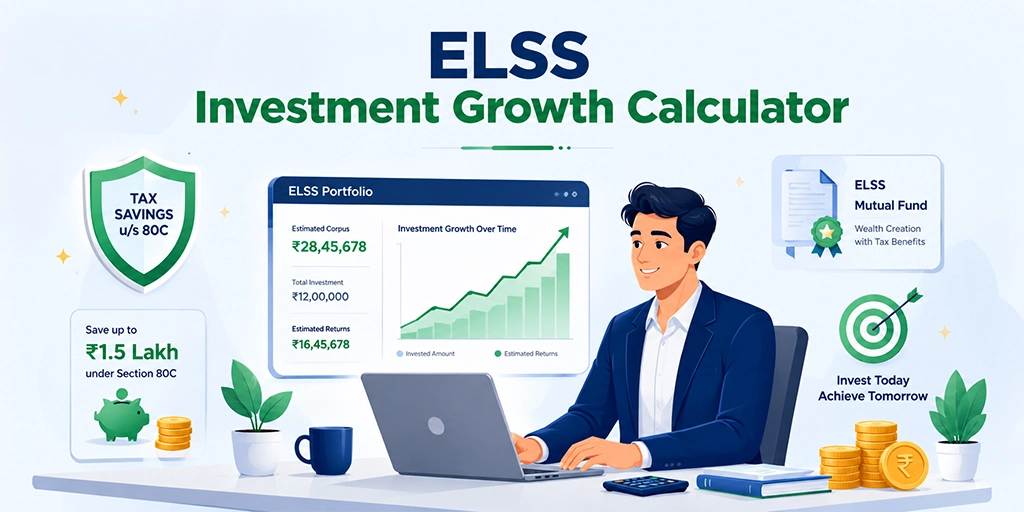
Finmarra’s ELSS Calculator helps to know precisely how much you can increase your investments and reduce the taxes that can be claimed under Section 80C – before even investing a rupee. Just put in the amount of your SIP/lump sum investment, enter the return rate, and let the calculator do its magic. It will display all figures including your expected corpus, expected return, and tax savings for the fiscal year 2025-26 on the same page.
What Is an ELSS Calculator?
An ELSS Calculator is a financial planning tool that provides an estimate of the amount that your Equity Linked Saving Scheme (ELSS) investment will grow by, along with tax benefits available under section 80C of the Income Tax Act.
The calculator takes your investment amount, expected return rate, investment period and tax slab and gives you an idea of your total investment, your corpus, your projected return and the tax savings. It can be used for both SIP (Systematic Investment Plan) and lump sum investments.
Equity-oriented ELSS funds' returns are subject to market variations and may not achieve the targeted returns. Your assumed return rate is used to give a planning estimate and not a guarantee from the calculator.
In summary, an ELSS Calculator is a valuable tool that streamlines tax-saving investment planning and enables investors to make informed financial decisions.
How Can an ELSS Calculator Help You?
An ELSS Calculator is a useful financial planning tool for investors looking to build wealth while reducing their tax liability under Section 80C.
Estimate Tax Savings
The calculator shows the potential tax savings available based on your investment amount and income tax slab. Investments up to ₹1.5 lakh in ELSS funds qualify for deductions under Section 80C under the Old Tax Regime.
Compare SIP and Lump Sum Investments
You can compare SIP and lump sum investment options to understand how different investment methods may affect your future corpus.
Visualize Long-Term Growth
Using any of the adjustment options above, you can determine how compounding can help create wealth in the long run.
Save Time and Improve Accuracy
The calculator instantly calculates your results, allowing you to compare various investment options without the need for manual calculations.
How to Use the ELSS Calculator
Step 1: Choose Your Investment Type
Select SIP if you plan to invest a fixed amount every month. Choose Lump Sum if you are making a one-time investment.
Step 2: Enter Your Investment Amount
For SIP investments, enter your monthly contribution amount. For lump sum investments, enter the one-time investment amount.
Step 3: Set Your Expected Return Rate
Enter the annual return rate you wish to use for projections. Many investors use 10% to 14% for long-term ELSS planning.
Step 4: Select Your Investment Duration
Choose the number of years you intend to stay invested. While ELSS has a mandatory 3-year lock-in period, longer investment durations may provide greater compounding benefits.
Step 5: Choose Your Income Tax Slab
Select your applicable tax slab under the Old Tax Regime. This helps estimate the tax deduction available under Section 80C.
Step 6: View Your Results
The calculator instantly displays:
- Total Investment
- Estimated Returns
- Maturity Value
- Potential Tax Savings
Inputs Required
- Investment Type: Choose either SIP or Lump Sum.
- Investment Amount: Enter your monthly SIP contribution or one-time investment amount.
- Expected Return Rate: Provide your estimated annual rate of return.
- Investment Duration: Select the number of years you plan to remain invested.
- Tax Slab: Choose your applicable income tax slab to estimate tax savings.
ELSS Calculator Formula
The ELSS Calculator uses standard financial formulas to estimate future investment value.
SIP Future Value Formula
Monthly Rate: r = (Annual Return Rate ÷ 12) ÷ 100
Number of Months: N = Years × 12
Future Value: FV = P × ((1 + r)N − 1) ÷ r × (1 + r)
Where:
P = Monthly SIP Amountr = Monthly Return RateN = Total Number of Months
Lump Sum Future Value Formula
FV = Principal × (1 + Annual Return Rate ÷ 100)Years
Tax Savings Formula
Tax Saved = Min (Investment Amount, ₹1,50,000) × Tax Slab Rate
What the Calculator Shows
Total Investment
The total amount invested during your selected investment period.
Estimated Returns
The projected earnings generated on your investment.
Maturity Value
The estimated corpus at the end of the investment period.
Tax Savings
The tax benefit available under Section 80C based on your selected tax slab.
Example ELSS Calculation
Example SIP Investment
Monthly SIP Amount: ₹5,000
Investment Duration: 10 Years
Expected Return: 12% Per Year
Tax Slab: 20%
Estimated Results
Total Investment: ₹6,00,000
Estimated Corpus: Approximately ₹11,61,000
Potential Tax Savings: Up to ₹30,000 annually under Section 80C
The above figures are estimates and actual returns may vary based on market performance.
SIP vs Lump Sum in ELSS
Both SIP and lump sum investments qualify for the same Section 80C tax deduction. The difference lies in how and when your money is invested.
| Factor | SIP Investment | Lump Sum Investment |
|---|---|---|
| Investment Style | Fixed monthly investment | One-time investment |
| Market Timing Risk | Lower | Higher |
| Compounding Start | Gradual | Immediate |
| Cash Flow Requirement | Easier to manage | Requires surplus funds |
| Suitable For | Salaried investors | Investors with available capital |
| Investment Discipline | Encourages regular investing | Single commitment |
Which Option Should You Choose?
SIP investments help reduce market timing risk and build investing discipline. Lump sum investments may generate higher returns during rising markets if invested at the right time. Use the calculator to compare both options and choose the one that aligns with your financial goals.
Advantages of Using an ELSS Calculator
Quick and Accurate Estimates
Get instant projections for returns and tax savings without manual calculations.
Better Investment Planning
Understand how your investment decisions may impact future wealth creation.
Easy Comparison of Investment Options
Compare SIP and lump sum investments using the same assumptions.
Supports Tax Planning
Estimate Section 80C benefits before making investment decisions.
Helps Set Long-Term Financial Goals
Project future corpus values and plan investments accordingly.
ELSS Tax Benefits Under Section 80C
ELSS investments qualify for tax deductions of up to ₹1.5 lakh per financial year under Section 80C of the Income Tax Act when filing under the Old Tax Regime.
| Tax Slab | Maximum Eligible Investment | Potential Tax Savings |
|---|---|---|
| 5% | ₹1,50,000 | ₹7,500 |
| 20% | ₹1,50,000 | ₹30,000 |
| 30% | ₹1,50,000 | ₹45,000 |
Taxation of ELSS Returns
When ELSS investments are redeemed after the lock-in period, gains are treated as Long-Term Capital Gains (LTCG).
- Gains up to ₹1.25 lakh per financial year are exempt from tax.
- Gains above ₹1.25 lakh are taxed at 12.5%.
- The exemption limit applies across all equity investments combined.
ELSS vs PPF vs Tax-Saving FD
| Feature | ELSS Mutual Funds | PPF | Tax-Saving FD |
|---|---|---|---|
| Lock-in Period | 3 Years | 15 Years | 5 Years |
| Return Type | Market Linked | Government Backed | Fixed Interest |
| Growth Potential | High | Moderate | Low |
| Section 80C Deduction | Up to ₹1.5 Lakh | Up to ₹1.5 Lakh | Up to ₹1.5 Lakh |
| Tax on Returns | LTCG Tax Applicable | Tax Free | Taxable |
| Inflation-Beating Potential | High | Moderate | Low |
ELSS offers the shortest lock-in period among major Section 80C investment options while providing the potential for higher long-term returns through equity market exposure.
Frequently Asked Questions About ELSS Investments
What is ELSS?
ELSS is actually the Equity Linked Savings Scheme. It is a tax-saving mutual fund scheme which shows a predominant equity-based form of investment and offers tax deductions under Section 80C.
How long is the lock-in period for ELSS?
ELSS investment has the shortest lock-in period of 3 years, compared to other investment options under section 80C.
Is ELSS return guaranteed?
No. ELSS funds invest in equity markets and their performance depends on market performance. Refunds cannot be given.
Can I invest in ELSS through SIP?
Yes. The majority of ELSS mutual funds offer an investment option of SIP as well as lumpsum investments.
What tax benefits does ELSS offer?
Under the Old Tax Regime, the investment in ELSS gets a deduction of up to ₹1.5 lakh per year in the income tax returns.
Can I claim ELSS deductions under the New Tax Regime?
No, Deductions under section 80C are not allowed in the New Tax Regime.
How is tax saving calculated?
The tax savings are based on the amount invested (maximum limit ₹1.5 lakh), and the applicable income tax slab.
Does ELSS have an exit load?
There is no exit load in the ELSS fund in the initial period of the mandatory lock-in period. Once the lock-in period is over, there may be rules for the specific funds.
Can I withdraw ELSS before 3 years?
ELSS investments are not liquidated before the minimum holding period of 3 years.
Is ELSS better than other Section 80C options?
Elss is one of the most growth oriented investment categories with the lowest lock-in period in the list of major investment options in Section 80C. But the most suitable option is based on your risk appetite and investment objective.
What is a good expected return rate for ELSS?
A lot of investors assume 10 to 14 percent returns for long-term investing. There is a possibility of actual returns differing from those indicated in the market.
Popular Calculators

Capital Gains Calculator

Car Loan EMI Calculator

Bond Yield Calculator

CAGR Calculator

Down Payment Calculator

Personal Loan EMI Calculator

Home Loan EMI Calculator

Fixed Deposit (FD) Calculator

ROI Calculator

Lumpsum Calculator

Mutual Fund Calculator

SSY Calculator

Financial Goal Planner Calculator

SWP Calculator

EPF Calculator

Inflation Calculator

Net Worth Calculator