Bond Yield Calculator
Estimate current yield and yield to maturity based on the bond inputs.
Bond Yield
Bond Yield & Return Calculator for Fixed Income Assets
Finmarra’s bond yield calculator is a tool designed to calculate various bond yield metrics and estimate the potential returns of bond investments, such as annual coupon income, current yield, yield to maturity (YTM), and maturity value based on the bond's face value, market price, coupon rate, and remaining tenure.
What Is a Bond Yield Calculator?
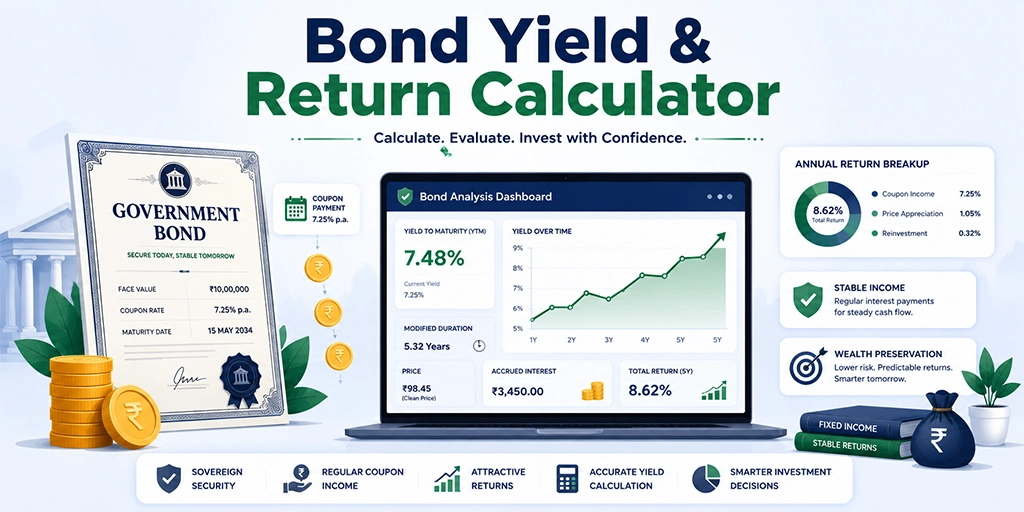
A bond yield calculator is a financial planning tool that calculates the expected return from an investment in a bond, based on the bond's purchase price, face value, coupon rate, and term to maturity.
The calculator can be used to estimate the following bond characteristics: annual coupon income, current yield, yield to maturity (YTM), and projected maturity returns. It is applicable to corporate bonds, government bonds, tax-free bonds and other fixed-income investments.
Bond prices are subject to changes in interest rates, market conditions and the credit quality of the bond issuer, and may not achieve the returns shown. The results are thus only a planning guide and not an actual promise.
To summarize, a Bond Yield Calculator streamlines bond return analysis and makes it easier to compare investors' fixed-income investment options prior to investing.
How Can a Bond Yield Calculator Help You?
A Bond Yield Calculator is a useful financial planning tool for investors looking to evaluate fixed-income investments and compare potential returns across different bonds.
Estimate Bond Returns
The calculator helps estimate annual coupon income, current yield, Yield to Maturity (YTM), and maturity value based on the bond's purchase price and tenure.
Compare Different Bond Investments
Bonds that are selling at a premium, discount or par can be compared to determine the impact on returns based on purchase price.
Evaluate Fixed-Income Opportunities
The calculator helps assess corporate bonds, government securities, tax-free bonds, and other debt instruments using consistent return metrics.
Save Time and Improve Accuracy
The calculator instantly performs complex yield calculations, allowing investors to compare multiple bond options without manual calculations.
How to Use the Bond Yield Calculator
Step 1: Enter the Bond's Face Value
Enter the bond's face value or par value. This is the principal amount that the issuer will repay at maturity.
Step 2: Enter the Current Market Price
Provide the price at which the bond is currently trading or the amount you plan to pay for the bond.
Step 3: Enter the Annual Coupon Rate
Enter the bond's annual coupon rate. This determines the interest income paid by the issuer during the bond's tenure.
Step 4: Select the Years to Maturity
Choose the number of years remaining until the bond reaches maturity and the principal amount is repaid.
Step 5: Choose the Interest Payment Frequency
Select how often the bond pays interest, such as annually, semi-annually, quarterly, or monthly.
Step 6: View Your Results
The calculator instantly displays:
- Annual Coupon Income
- Current Yield
- Yield to Maturity (YTM)
- Effective Annual Yield
- Maturity Value
Inputs Required
- Face Value: Enter the bond's par value or the amount that will be repaid at maturity.
- Current Market Price: Provide the bond's current purchase price in the market.
- Annual Coupon Rate: Enter the fixed annual interest rate offered by the bond.
- Years to Maturity: Select the remaining period until the bond matures.
- Interest Payment Frequency: Choose how often coupon payments are received during the bond's tenure.
Bond Yield Calculator Formula
The Bond Yield Calculator uses standard bond valuation and yield formulas to estimate returns.
Annual Coupon
Annual Coupon = Face Value * Coupon Rate%
Current Yield Formula
Current Yield % = (Annual Coupon Payment ÷ Current Bond Price) × 100
Yield to Maturity (YTM) Approximation Formula
YTM ≈ (C + (F − P) ÷ n) ÷ ((F + P) ÷ 2)
Here:
- C = yearly coupon payment
- F = face value of the bond
- P = current price of the bond
- n = years to maturity
This gives a quick estimate.
For exact YTM, you solve this equation:
P = Σ [C ÷ (1 + YTM)^t] + [F ÷ (1 + YTM)^n]
Total Coupons
Total Coupons = Annual Coupon * Years to Maturity
Total Return
Total Return = Total Coupons + Face Value
Monthly Cashflow
Monthly Coupon = Annual Coupon / 12
Effective Annual Yield Formula
Effective Annual Yield = (1 + Nominal Rate ÷ Number of Payment Periods)^(Number of Payment Periods) − 1
What the Calculator Shows
Annual Coupon Income
The total interest income expected from coupon payments during a year.
Current Yield
The annual income from a bond divided by the bond's current market price and multiplied by 100.
Yield to Maturity (YTM)
The expected annualized return on the bond assuming that the bond is held to maturity and all coupons are received as scheduled.
Effective Annual Yield
The annualized yield after considering the effect of compounding based on coupon payment frequency.
Maturity Value
The principal amount is expected to be received from the issuer when the bond reaches maturity.
Example Bond Yield Calculation
Example Bond Investment
Face Value: ₹10,000
Current Market Price: ₹9,500
Annual Coupon Rate: 8%
Years to Maturity: 5 Years
Interest Payment Frequency: Annual
Estimated Results
Annual Coupon Income: ₹800
Current Yield: 8.42%
Estimated Yield to Maturity (YTM): Approximately 9.15%
Maturity Value: ₹10,000
The above figures are estimates, and actual returns may vary based on market conditions and bond performance.
Premium Bonds vs Discount Bonds
Premium bonds offer fixed coupon payments, as do discount bonds, but the return is dependent upon the price paid and the face value of the bond.
| Factor | Discount Bond | Premium Bond |
|---|---|---|
| Purchase Price | Bought below face value | Bought above face value |
| Yield to Maturity (YTM) | Usually higher than coupon rate | Usually lower than coupon rate |
| Capital Movement at Maturity | Potential gain as value moves toward par | Potential loss as value moves toward par |
| Income Profile | Balanced income and capital appreciation potential | Higher coupon income relative to purchase price |
| Suitable For | Investors seeking higher overall returns | Investors focused on regular income |
| Return Driver | Coupon income plus potential capital gain | Primarily coupon income |
Which Option Should You Choose?
Investors looking for greater potential capital appreciation and higher YTM may prefer the discount bond, while those who prefer regular coupon income may prefer the premium bond. Compare bond yields and assess bond options using the Bond Yield Calculator.
Advantages of Using a Bond Yield Calculator
Quick and Accurate Yield Estimates
Calculate key bond metrics such as coupon income, current yield, and Yield to Maturity (YTM) without manual computation.
Better Fixed-Income Planning
Understand how purchase price, coupon rate, and maturity period influence potential bond returns.
Easy Comparison of Bond Options
Compare different bonds using consistent yield measures to evaluate income and return potential.
Supports Investment Decisions
Assess corporate bonds, government securities, and other fixed-income instruments before investing.
Helps Evaluate Long-Term Returns
Estimate income and maturity outcomes to support long-term fixed-income planning.
Understanding Bond Taxation
Bond returns include coupon income and capital gains, and taxation depends on bond type, holding period, and applicable tax rules.
- Coupon interest is taxed as per income tax slab
- Listed bond capital gains depend on holding period rules
- Unlisted bond gains follow applicable tax provisions
- Tax-free bonds may offer exempt interest income, subject to rules
Corporate Bonds vs Government Securities vs Fixed Deposits
| Feature | Corporate Bonds | Government Securities (G-Secs) | Bank Fixed Deposits |
|---|---|---|---|
| Issuer | Companies / financial institutions | Government of India | Banks |
| Return Type | Coupon + capital gains | Interest income | Fixed interest |
| Risk Level | Medium (issuer dependent) | Very low | Low |
| Liquidity | Tradable in secondary market | Tradable | Limited liquidity |
| Return Potential | Higher | Moderate | Lower |
| Suitability | Return-focused investors | Conservative investors | Capital preservation |
Corporate bonds generally offer higher yield potential, while government securities and fixed deposits are preferred for stability and lower risk.
Frequently Asked Questions About Bond Yield Calculator
How is Yield to Maturity (YTM) calculated in a Bond Yield Calculator?
Yield to Maturity (YTM) is based on the face value, current market price, coupon payments and remaining years to maturity. Finmarra's Bond Yield Calculator considers these elements to calculate the annualized return of the bond if it is held to maturity.
What is the difference between Current Yield and Yield to Maturity (YTM)?
Current Yield is the annual amount of the bond's coupons divided by the bond's current market price. YTM is more comprehensive, taking into account the return on the Coupon payments, purchase price, face value, and time until maturity.
Can I use the Bond Yield Calculator for corporate bonds and government securities?
Yes. If you have the necessary information about the bond, the Bond Yield Calculator can be used to estimate yields for corporate bonds, government securities (G-Secs), tax-free bonds and other fixed-income securities.
Why is the Yield to Maturity higher than the coupon rate on some bonds?
When a bond is sold for less than par, its YTM can be greater than the coupon rate. When this occurs, the return will consist of the interest received on the bond along with the bond's gain at maturity.
How does the market price of a bond affect bond yield?
As bond prices go up, yields go down.When bond prices rise, bond yields fall. As a bond's market price decreases, the yield increases. As the market price increases, the yield will typically decline. This relationship is explained to investors by using clear yield calculations.
What information is required to calculate bond yield accurately?
Bond yield is usually computed with the help of the face value of the bond, the current market price of the bond, the annual coupon rate, the term to maturity, and the frequency of receiving interest. These inputs are used to calculate some outputs such as current yield, coupon income and YTM.
Can I compare multiple bond investments using the Bond Yield Calculator?
Yes. Different bonds can be compared by typing in the price, coupon rate, and maturity of each bond. This will help you to determine the bond with the right yield and income characteristics for your investment goals.
Is Yield to Maturity a guaranteed return?
No, Yield to Maturity is an estimation based on a bond's being held until its maturity and all the scheduled payments are received. Actual returns are subject to the market conditions, reinvestment rates or the credit quality of the issuer.
Should I choose a premium bond or a discount bond?
The selection is dependent on what you want to invest your money in. Discount Bonds can drive up the YTM and premium bonds can drive up the coupon income. Finmarra's Bond Yield Calculator allows you to compare both options on the same terms of yield.
How can a Bond Yield Calculator help with fixed-income investment planning?
A Bond Yield Calculator can be used to estimate the income from coupons, the current yield, and YTM before investing. Comparing bond investments allows for better understanding of fixed-income investment opportunities and helps to assess potential bond returns more clearly.
Popular Calculators

ELSS Calculator

Capital Gains Calculator

Car Loan EMI Calculator

CAGR Calculator

Down Payment Calculator

Personal Loan EMI Calculator

Home Loan EMI Calculator
Fixed Deposit (FD) Calculator

ROI Calculator

Lumpsum Calculator

Mutual Fund Calculator

SSY Calculator

Financial Goal Planner Calculator

SWP Calculator

EPF Calculator

Inflation Calculator

Net Worth Calculator